The skittle rainbow experiment looks at sugar dissolving in warm water and osmosis. Place skittles around the edge of a white plate, alternate the colours making a rainbow pattern with the skittles. Add a small amount of warm water to cover the bottom of the plate. The colours starts to move towards the centre. Ask your child what is happening to the sweets? Why is the colour coming off the sweets? Talk about the coloured sugar coating is dissolving due to the warm water and we can see the sugar in the water. The coloured sugar is moving and creating a straight line to the centre due to osmosis. The colour particles from the skittles move from a high concentration - the sweets, to a low concentration, through a permeable solution. Thomas enjoyed swirling the plate and making the colours go a brown colour! Don't forget to save a few skittles to eat as a treat. 😉
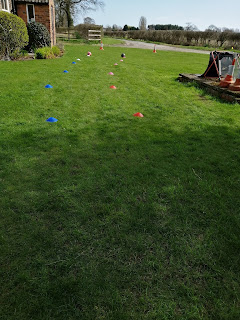
I've named this the 4 marker challenge! Use 4 cones or 4 old cloths as a marker. Set the 4 markers a metre apart from each other some distance from a start line and finish line. You could use a marker for start and finish lines. From the start line run to marker one and back, then run to marker two and back, run to 3 and back then 4 and back, then first to finish line is the winner. If only one child doing it you could time them to get quicker each day. You can adapt this activity. Eg a) Run to marker 1 and back repeat b) Hop to marker 1 and back repeat c) Use a football and dribble to marker one and back d) Football kick ball to marker 1 and back repeat e) Bounce ball to marker 1 and back f) throw tennis ball at marker 1 and back g) throw tennis ball in air repeatedly as running to marker 1 and back h) if you have a hockey stick dribble hockey ball to marker 1 and back I) shoot hockey ball to marker 1 and back. Th...
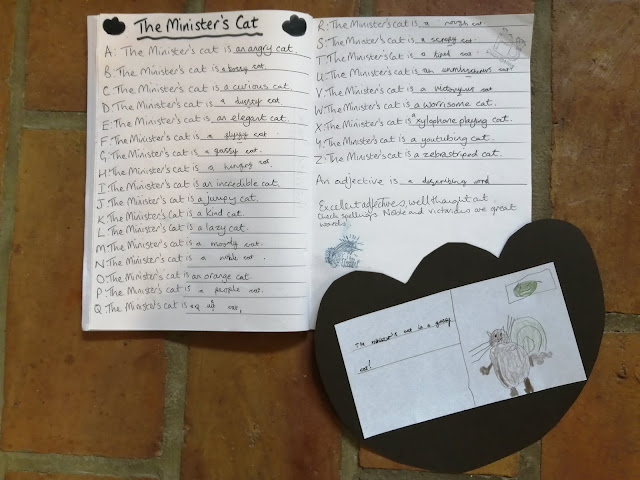
Discuss what an adjective is. An adjective is a describing word. It describes a noun - describes the object, person or place. I wrote out the alphabet and then the sentence - The Minister's Cat is a _______ cat. For each letter of the alphabet we thought of a word to describe the cat. Eg N - The Minister's Cat is a noble cat. We took it in turns to think of the adjectives. We watched a video of a reading of Lynley Dodd's The Minister's Cat ABC which you can find on youtube. We took it in turns to read out our sentences when we had finished. Thomas picked out his favourite sentences and wrote it out and drew the cat, illustrating the adjective. Thomas chose The Minister's Cat is a gassy cat! I stuck the sentence and illustration onto a paw print.

Comments
Post a Comment