Posts

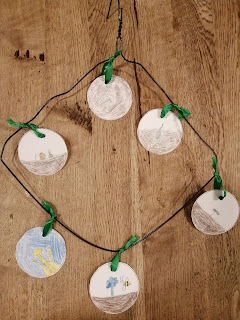
Life Cycle Of A Plant Mobile
Image
Life Cycle Of A Plant. We watched the video clip on BBC bitesize on the life cycle of a plant. https://www.bbc.co.uk/bitesize/topics/zgssgk7/articles/zyv3jty Then on white card cut into circles, we drew the 6 stages of the life cycle of the plant. The seed starts to grow shoots and roots in the ground.  The seed germinates and the shoot grows and appears above ground.  The seedling produces leaves which absorb sunlight in a process called photosynthesis.  The flower head grows, makes pollen and attracts bees, this is called pollination.  The fertilisation of the flower takes place and tiny seeds are produced.  Seed dispersal takes place usually when the flower head dies off. Seeds can be dispersed by the wind, drop to the ground or moved by animals.  The process then starts again with the new seeds, the life cycle begins again. We drew the pictures on the front of our cards and wrote what happened on the back. We hole punched the card a...

Snakes and Ladders Spelling Game

Image
Play snakes and ladders to practise spellings. We have a list of Year 3 / 4 Common Exception words. We are trying hard to learn these words by playing Snakes and Ladders.  I wrote all the spellings onto card. When it's your turn, roll the dice and opponent picks a card and you have to spell it correctly before you can move, or before you go up the ladder or to avoid going down the snake. I sometimes spell the words wrong to talk about how they are spelt. A friend and her daughter made their own snakes and ladders sheet before they started and it's now their favourite activity to do! Who knew spelling practise could be so fun! 😂🤣

Hopscotch

Image
We played hopscotch yesterday. Not sure we've ever played it before. Thomas was doing a reading comprehension about hopscotch so afterwards we went into the yard and drew the hopscotch and played the game. Drawing the hopscotch is good for numbers and drawing squares! Playing the games is great exercise - jumping, hopping and balancing to pick up the stone! We laughed and had lots of fun. If you want to add an extra learning element then you could practise maths or spellings by answering a question before you pick up the stone or before you have your turn. A golden oldie we had forgotten about.

Spelling Dice Game

Image
Learn spellings with a spelling dice game. Divide an A4 sheet into six columns. Draw one dice face at top of each column and put a different number on each dice face. Write words in the columns from your child's spelling list (could be reading list if your child is younger). We made this game a few years ago. To play, roll the dice. If you roll a one the other player takes the sheet and picks a word for the player to spell from the one column. If they spell it correctly they get a point. Take it in turns. If they spell the word wrong then look and talk about how they spelt it wrong and how to spell correctly. (Adult could get some wrong on purpose to talk about how to spell correctly.) If reading then pick a word for the child to read, get a point for reading correctly. Could tick words as read them.

PE Lesson With Miss Welch - Lesson 1

Image
PE lesson with Miss Welch - Lesson 1.  This lesson has a warm up, 10 exercises (eg star jumps, windmill, burpees, plank etc) and a cool down. Takes about 17 minutes so you could start the morning with this or fit it into a break to re-energise.

DIY Plant Pots For Sowing Seeds

Image
Make a plant pot for sowing seeds from toilet roll holders and kitchen roll holders. Cut kitchen roll holder in half so end up with two the size of toilet roll. Cut vertical cuts at one end about 2 cms high, usually about 4/5 cuts, then fold the flaps in to make a base. I didn't tape the bottom. Hold bottom when fill with compost and plant seed. Place into a container (margarine/icecream tub to keep in place.) When seed germinates and seedling ready to transplant, put whole thing in the ground as holder will decompose in the ground.

Animal Facts

Image
We saw a bat sleeping on the door to one of our barns. We managed to get a photograph of it without disturbing it, I have cropped the photo and enlarged it.  I printed out the photo and we used wildlife books to find out some facts about bats. We wrote factual sentences on bat shaped card. This is a pipistrelle bat.  They eat moths and other flying insects.  This bat can fly to a height of 2-6m. There are approximately 1400 bat species in the world.  We may extend the sentences another time using conjunctions and connectives. Connectives can be conjunctions eg but, when, because or connecting adverbs eg however, then, therefore. There are approximately 1400 bat species in the world, however there are only 18 bat species in the UK.  You can write facts about any animal your child is interested in or might have seen in your garden. You can use the internet to research the animal if you don't have any books. We have a pond on our farm and have ...